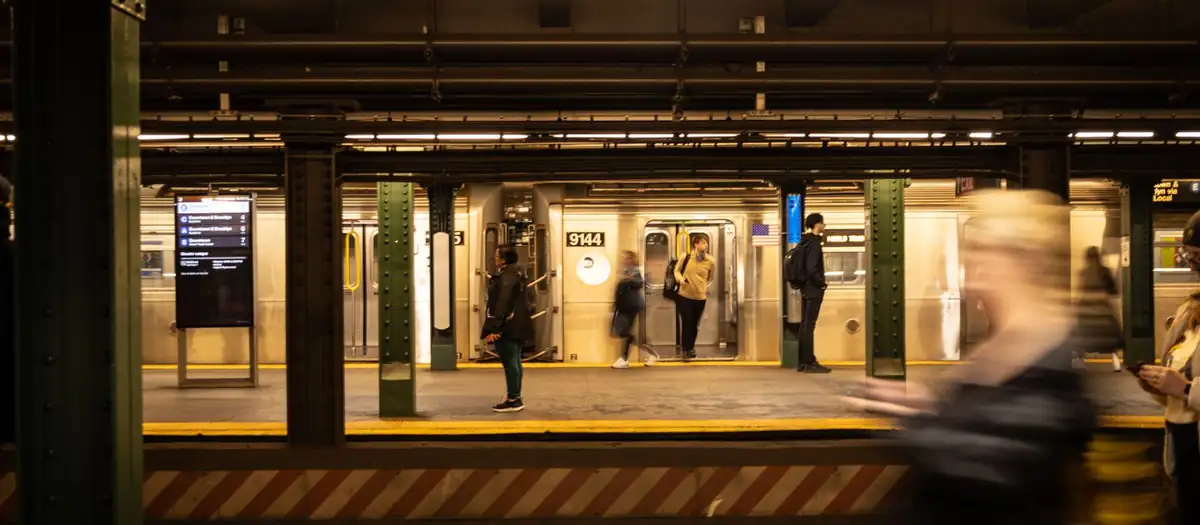
Can I live in the USA without a car?
San Francisco, New York and Boston are the most walkable big cities in the US, with Chicago, Miami and Washington DC not far behind, and all have usable public transport. Los Angeles, and especially Austin, are built much more around the car.
In 30 seconds
- Each city has its own card: OMNY in New York, CharlieCard in Boston, SmarTrip in Washington DC, Ventra in Chicago, EASY Card in Miami, TAP in Los Angeles and Clipper in San Francisco. In most you can also tap a contactless bank card or phone
- Fare caps and passes limit what you pay: in New York you ride free after $35 in seven days, and in Los Angeles after $18
- Our calculator budgets from $41.25 a month in Austin to $152 in New York. If your employer offers a commuter benefit, you can pay up to $340 a month of fares before tax
Can you manage without a car?
It depends far more on the neighbourhood than the city. Living near a subway, Metro or train station, with work in the centre, many people manage well. In the suburbs, buses can be infrequent and shops, schools and doctors far apart, so a car becomes a necessity. Before you sign a lease, try the commute at rush hour and check evening and weekend service. See Where should we live? and How do I find a place to rent?
| City | Walk Score | What it means |
|---|---|---|
| San Francisco | 89 | The most walkable large US city in Walk Score’s ranking |
| New York | 88 | 2nd |
| Boston | 83 | 3rd |
| Chicago | 77 | 4th |
| Miami | 77 | 6th |
| Washington DC | 77 | City average |
| Los Angeles | 69 | 12th: “somewhat walkable” |
| Austin | 42 | 30th: “car-dependent” |
Walk Score rates how easily you can do daily errands on foot, out of 100. City averages hide big differences: check the score for the actual address you are thinking of renting.
Cards and fares by city
| City | Card | Adult fare | Caps and passes | Our monthly figure |
|---|---|---|---|---|
| New York (MTA) | OMNY | $3.00 subway and local bus | Ride free after $35 in 7 days ($67 including express buses) | $152 (about £115) |
| Boston (MBTA) | CharlieCard | Subway $2.40; bus $1.70 | Monthly LinkPass $90; 7-day pass $22.50 | $90 (about £68) |
| Washington DC (WMATA) | SmarTrip | Metrorail $2.25 to $6.75 on weekdays by distance; $2.25 to $2.50 evenings and weekends. Metrobus $2.25 | Monthly pass $72 to $216, by fare level; 7-day pass $60.75 | $108 (about £82) |
| Chicago (CTA) | Ventra | “L” train $2.50; bus $2.25 | 1-day $5, 7-day $20, 30-day $75 (also valid on Pace buses) | $75 (about £57) |
| Austin (CapMetro) | Reloadable Fare Card or Umo app | Local $1.25; express and rail $3.50 | Local capped at $2.50 a day and $41.25 a calendar month | $41.25 (about £31) |
| Miami (Miami-Dade Transit) | EASY Card | Metrorail and Metrobus $2.25; Metromover free | Daily cap $5.65; 7-day pass $29.25; 1-month pass $112.50 | $112.50 (about £85) |
| Los Angeles (Metro) | TAP | $1.75 | Ride free after $5 a day or $18 in 7 days | $78 (about £59) |
| San Francisco (Muni) | Clipper | $2.85 by Clipper, app or bank card; $3.00 cash | Monthly “M” pass $86; “A” pass with BART inside San Francisco $104 | $86 (about £65) |
“Our monthly figure” is what our cost of living calculator uses for one adult commuting by transit. Fares usually change once a year, and Austin’s rise on 10 January 2027. Check the operator’s website before you budget
New York: OMNY
- Tap a contactless bank card, or a phone or watch, at an OMNY reader on the subway or bus. If you prefer cash, buy and load an OMNY Card
- The weekly cap only works if you tap the same card or device every time. Your first tap starts a new seven-day period
- Reduced-fare riders are capped at $17.50 in seven days. Group trips and transfers don’t count towards the cap
- MetroCard sales ended on 31 December 2025. Old cards were still accepted into 2026, but check the MTA for the final date
- Citi Bike, the bike share, costs $4.99 for 30 minutes, $25 for a day or $239 a year
Boston and Washington DC
- Boston: pay with a CharlieCard, CharlieTicket, contactless bank card or cash on the subway, buses and ferries. From 1 September 2026, on a trial basis, express buses cost the same as local buses, and you can make unlimited transfers between subway, bus and ferry within two hours using the same payment
- Washington DC: tap a SmarTrip card, or a contactless bank card or phone, at the faregates both when you enter and when you leave, using the same card. Rail fares depend on distance and time of day. A new SmarTrip card costs $2
- DC transfers: bus to bus is free within two hours, and bus to rail or rail to bus gets a $2.25 discount
Chicago and Austin
- Chicago: pay with a Ventra card or tap a contactless bank card. Up to two more rides within two hours are free. Boarding the “L” at O’Hare airport costs $5, unless you have a pass
- Austin: tap a contactless bank card or phone on buses for a daily cap. For the monthly cap too, use the free CapMetro Reloadable Fare Card (from the Transit Store or participating H-E-B shops) or the Umo app
- Austin is the most car-dependent of our eight places. Its bike share costs $2.50 to unlock plus 25 cents a minute, or $25 for 31 days of rides up to 30 minutes
Miami, Los Angeles and San Francisco
- Miami: tap a contactless bank card, a phone, or an EASY Card ($2). On Metrorail you only tap to enter. Metromover is always free
- Los Angeles: pay with a TAP card or the TAP app. Transfers are free within two hours. Seniors aged 62 and over pay no more than $2.50 a day or $5 in seven days
- San Francisco: Clipper works on all Bay Area transit systems, including Muni. A contactless bank card also works but is always charged the full adult fare, so discounts need Clipper. Young people aged 18 and under ride Muni free, except on cable cars, which cost $9 a ride
Ride-hailing and taxis
Ride-hailing apps such as Uber and Lyft fill the gaps, especially late at night or with luggage. Waymo’s driverless taxis run in parts of several cities, including San Francisco, Los Angeles, Austin and Miami: check its website for current areas. Tipping drivers is customary: in a 2023 Pew Research Center survey, 61% of people who use taxis or ride-hailing said they always or often tip.
Trains between cities
Amtrak runs intercity trains. Its fastest service, Acela, runs on the Northeast Corridor between Boston, New York and Washington DC. Its new NextGen Acela trains, which can reach 160mph, entered service in August 2025, with all 28 due by the end of 2027. In Florida, Brightline runs between Miami and Orlando, about three hours non-stop. Elsewhere, distances are long and most people fly or drive. For trips away, see Weekends away in the USA.
What to do next
- Test your commute on the city’s transit app before you sign a lease
- Tap the same bank card or phone every time in your first weeks, then decide whether the city’s card or a pass is cheaper
- Ask HR whether your employer offers a pre-tax commuter benefit
Keep going
- OMNY (MTA): Fares and the weekly fare cap
- OMNY (MTA): How to tap and ride
- PoliticsNY: MTA to end MetroCard sales by 31 December 2025 (Mar 2025)
- Citi Bike: Pricing
- MBTA: Subway fares
- MBTA: Bus fares and the fall 2026 fare pilots
- WMATA: Metro fares
- WMATA: Passes
- WMATA: Tap. Ride. Go. (contactless payment)
- CTA: Fares
- CapMetro: Fares
- Miami-Dade County: Transit fares and parking fees
- LA Metro: Fares
- SFMTA: Muni fares
- Clipper: Contactless payments
- Walk Score: Cities and neighbourhoods ranking
- Walk Score: Austin, Texas
- Waymo: Where we operate
- Railfan & Railroad: NextGen Acela enters revenue service (Aug 2025)
- FOX 35 Orlando: How long is the Brightline ride from Orlando to Miami? (2023)
- IRS: Tax inflation adjustments for tax year 2026 (qualified transportation benefit)
- Pew Research Center: Tipping culture in America (Nov 2023)