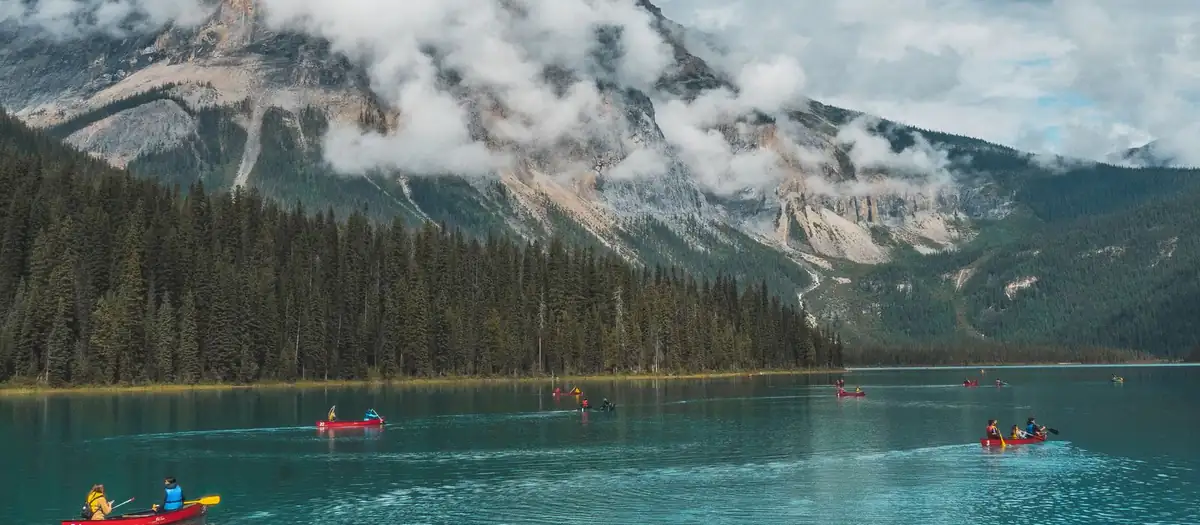
How do we make the most of a Canadian summer?
Canadian summers are short, hot and busy. From late June to early September, people head for lakes, cottages, campsites and national parks. Summer also brings wildfire smoke, heat warnings, ticks and bears, and a little preparation lets you enjoy it safely.
In 30 seconds
- Popular national park campsites are booked online months ahead, from January or February. A Discovery Pass covers entry to Parks Canada places for a year
- Check the Air Quality Health Index (AQHI) on smoky days: 7 to 10 is high risk, and 10+ is very high
- Check for ticks after time in long grass or woods, carry bear spray in the mountains, and wear a lifejacket on the water
Lakes, cottages and camping
Summer life in Ontario and Quebec revolves around “cottage country”: lakes a few hours north of the city where families rent or own a cabin. Friends may invite you up for a weekend. In the west, people head to the mountains, the Okanagan lakes and the coast. Rentals and campsites fill up early, especially on long weekends.
National parks, national historic sites and marine conservation areas are run by Parks Canada. Most campsites are booked through the Parks Canada reservation service, online or on 1-877-737-3783. Booking for the 2026 season opened park by park in late January and early February (Jasper’s frontcountry camping, for example, opened on 27 January at 8am Mountain Time), and the best sites go within minutes. Provincial parks, such as Ontario Parks and BC Parks, have their own booking systems.
| Pass | Price | What it covers |
|---|---|---|
| Discovery Pass, adult | C$83.50 | 12 months’ entry to more than 80 Parks Canada places |
| Discovery Pass, senior | C$71.50 | The same, for seniors |
| Discovery Pass, family or group | C$167.50 | Up to 7 people arriving together in one vehicle |
| Under 18s | Free | No pass needed |
The pass covers entry only. Camping, reservation fees, some guided programmes and backcountry permits cost extra, and it isn’t valid in provincial parks. In summer 2026 the federal Canada Strong Pass gave free entry to Parks Canada places and 25% off camping from 19 June to 7 September. That offer has ended, and regular fees apply again. Check current fees and offers with Parks Canada
Wildfire season and smoke
Wildfires are now a normal part of Canadian summers. By 21 July 2026 almost 3.04 million hectares had burned, the third-largest total for that point in the year, after 2023 and 2025. Smoke can travel hundreds of kilometres: in mid-July 2026 Toronto’s AQHI reached 10+ because of fires in north-western Ontario.
| AQHI | Risk | What to do |
|---|---|---|
| 1–3 | Low | Enjoy being outside |
| 4–6 | Moderate | Consider cutting back if you have symptoms |
| 7–10 | High | Reduce or reschedule strenuous activity outdoors. Children and older people should take it easy |
| 10+ | Very high | Usually caused by wildfire smoke. Avoid strenuous activity outdoors |
Check the AQHI in the WeatherCAN app or your local forecast. Quebec uses its own smog index. On smoky days, keep windows closed and run an air purifier if you have one.
Campfire rules change through the season. In BC, the BC Wildfire Service bans campfires in fire centres when the risk is high, and a ticket for breaking a ban is C$1,150. Where fires are allowed, a campfire there must be no bigger than 0.5 metres high and wide, with a shovel or at least 8 litres of water to hand. Check your province’s fire bans before you light anything.
Heat and sun
Summers in Toronto, Montreal and Ottawa can be hotter and more humid than British ones. Environment Canada issues heat warnings: in southern Ontario, when two or more days in a row are forecast with highs of at least 31°C and lows of at least 20°C, or a humidex of 40 or more. Other regions use their own thresholds. Many older flats have no air conditioning, so find a cooling centre, library or mall nearby.
Health Canada says the UV Index can reach 3 or more from 11am to 3pm between April and September, even on cloudy days. At 8 to 10 (“very high”), unprotected skin burns quickly. Use broad-spectrum, water-resistant sunscreen of at least SPF 30, and cover up.
Ticks, mosquitoes and bears
- Ticks: blacklegged ticks, which can carry Lyme disease, are established in parts of Ontario, Quebec, Manitoba, New Brunswick, all of Nova Scotia and southern BC, and are spreading. After walks in woods or long grass, check yourself, children and pets. See a doctor if you get a rash or fever after a bite
- Mosquitoes and blackflies: they’re worst at dawn and dusk. Health Canada says adults and children over 12 can use repellent with up to 30% DEET, children aged 2 to 12 up to 10%, and babies under 6 months none: use a net. Icaridin is an alternative
- Bears: in bear country, carry bear spray in a holster, not your pack, make noise on the trail and never feed wildlife. If you meet a bear, stay calm, don’t run, speak firmly and back away slowly. Spray works at about 5 metres
On the water
Lakes stay cold well into summer, and drowning deaths are a real concern: BC recorded 93 in 2025. Transport Canada requires a lifejacket on board for each person, but adults don’t have to wear one, so choose to.
- To drive a motorboat, you need proof of competency, usually a Pleasure Craft Operator Card from an accredited online course and test
- If you rent a motorboat, the rental company’s safety checklist counts as proof for the rental period
- Don’t swim alone, and watch children closely at the cottage dock
What to do next
- Note when next year’s Parks Canada reservations open and be online at launch time
- Install WeatherCAN to see the AQHI, heat warnings and UV
- Buy bear spray and tick tweezers before your first trip, and book a boating course if you’ll drive a boat
Keep going
- Parks Canada: Fees, Banff National Park
- Parks Canada: Fees at La Mauricie National Park
- Parks Canada: Travel trade admission fees
- Parks Canada: Offer ended: free admission and discounted camping (Canada Strong Pass)
- Parks Canada: Parks Canada reservations
- Parks Canada: Tent and RV camping, Jasper National Park
- Government of Canada: Wildfire smoke, air quality and your health
- Government of Canada: Wildfire smoke, air quality and your health: overview
- United Nations University INWEH: Ontario wildfire smoke in mid-July (Jul 2026)
- BC Wildfire Service: Category 1 campfire prohibition, Kamloops Fire Centre (2026)
- Government of Canada: Extreme heat events and heat warnings
- City of Toronto: About Toronto’s Heat Relief Strategy
- Health Canada: The ultraviolet index and your local forecast
- Health Canada: Sun safety basics
- Public Health Agency of Canada: Lyme disease: spread, prevention and risks
- Public Health Agency of Canada: Ticks in Canada
- Health Canada: Personal insect repellents
- Public Health Agency of Canada: Prevention of West Nile virus
- Parks Canada: Safe travel in bear country
- Parks Canada: Bear spray
- Transport Canada: Pleasure Craft Operator Card (PCOC)
- Transport Canada: Operator card (PCOC) FAQ
- The Weather Network: B.C. drowning deaths rise sharply as safety groups urge life-jacket use (2026)